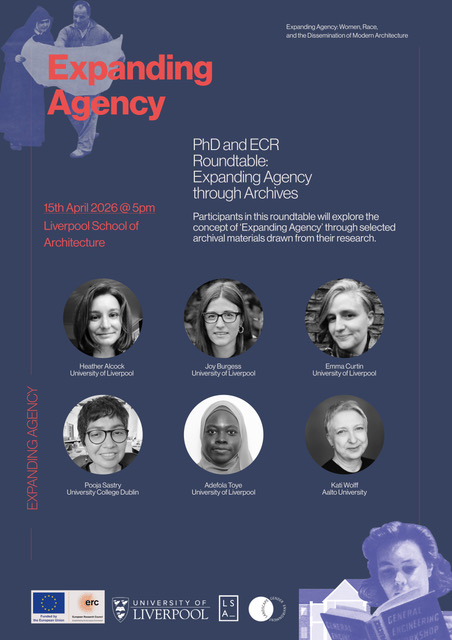
This round-table was organised as part of the exhibition series of the project which funds my research, and I was invited by Luca Csepely-Knorr and Juliana Kei from the Liverpool School of Architecture to share my own interpretation of ‘agency’ as I use it in my work. I was fortunate to share this platform with the accomplished scholars who participated in the round-table with me: Heather Alcock, Joy Burgess, Emma Curtin, Adefola Toye and Kati Wolff.
The following are the words of my own presentation:
I want to try and offer a little counterpoint to ‘Expanding Agency’ and argue that maybe agency is not made of an expandable or stretchable fabric. Is agency the best concept to discuss what we want to discuss? Maybe. And maybe not.
My images here are from two magazines published in the 1930s, you’ve probably also seen them on the posters in the exhibition space. The one on the left in British India and the one on the right in Argentina.


In my dissertation, I write about the ‘bourgeois domestic imaginary’. I don’t study real buildings but idealised domestic spaces that were sold to the public as aspirational and modern. Bourgeois domesticity was the ideal of the so-called ‘respectable’ middle class, centering the unwaged housewife in the home – cooking, cleaning, childrearing, and decorating, while reliant on the labour of domestic workers. Today, contemporary social media tradwives with ‘cottage-core’ aesthetics, ‘barefoot and pregnant’ and whatever are unfortunately recycling these sorts of bourgeois domestic images as their source material.
In the image from British India, the housewife dries dishes, while the domestic worker behind her kindles the stove. In the image from Argentina, the housewife and her husband greet guests in the dining room or parlour, while two domestic workers in the foreground cook dinner in the kitchen. Both are very modern images, showing aspirational modern commodities and styles of clothing.
The question I ask myself is: what kinds of agency did the bourgeois domestic imaginary offer to each of the people in these images?
The domestic worker in British India, for example, was almost certainly a member of an oppressed caste community, hired at low wages to perform back-breaking labour in the violent Hindu caste system, which in the 1930s were being centered as ‘national culture.’ In Argentina. domestic workers were also hired at low wages because of their marginalised racial identities. In both images, housewives are depicted as having a certain kind of agency in the way that the domestic workers do not.
So should I then excavate from the archive the domestic workers’ agency? Should I, in the in the act of attempting to find their agency, present them not as victims, but as free agents who simply have fewer choices? Is agency is a continuum? Less agency, more agency?
Walter Johnson asks us to scrutinise the relationship of ‘agency’ to ‘resistance’, in which ‘agency’; means everyday forms of resistance, but not revolutionary resistance, which is different and undesireable. Johnson urges us to consider that this definition of agency as everyday resistance reinforces the 19th century notion of the liberal subject, with its emphasis on independence and choice, which, in fact, was the very dividing line between white enslavers and enslaved people from the African continent.1
Lynn Thomas points out that in the years since Johnson’s essay, scholars and activists like the Combahee River Collective, Ifi Amadiume and Chandra Mohanty have shown how the concept of agency has been used to misconstrue the experiences of marginalised women. These scholars have asked challenging and necessary questions of who should be allowed to study whom, and who should be allowed to speak on behalf of whom.2
Kristina Alexander suggests that ‘implication’ may be a useful way to understand agency. Drawing on holocaust historian Michael Rothberg’s work, Alexander suggests that implication is a collective, and not necessarily conscious form of agency through which some people “contribute to, inhabit, inherit, or benefit from regimes of domination” without actually originating, or controlling those regimes themselves.3
There is a lot to think about here. Which of us has the right to expand or redefine agency? And more importantly, on whose behalf do we speak?
I am an oppressor caste woman from Karnataka in South India. I have unearned caste privilege, and at various points of my life, I myself have benefited from the low-waged labour of domestic workers who were from oppressed caste communities.
I don’t think it is for me to say whether the domestic workers represented here had agency, or to ‘discover’ the modes they employed to critique unjust systems of structural inequality. But I suggest that there is a need for us as researchers to continually pay attention to what Lynn Thomas calls “multiple, intersecting, and shifting forces and concerns.”
We have the privilege and responsibility of having access to archives. We must never become comfortable, and we must keep looking for better analytical frames to complicate agency.
For more on the participants of the round-table, visit https://www.liverpool.ac.uk/architecture/events/listings/202526lectures/phdandecrroundtable/
- Walter Johnson, ‘On Agency’, Journal of Social History 37, no. 1 (2003): 113–24. ↩︎
- Lynn M. Thomas, ‘Historicising Agency’, Gender & History 28, no. 2 (2016): 324–39. ↩︎
- Stephanie Olsen et al., ‘A Critical Conversation on Agency’, The Journal of the History of Childhood and Youth 17, no. 2 (2024): 169–87. ↩︎
 poojasastry.com