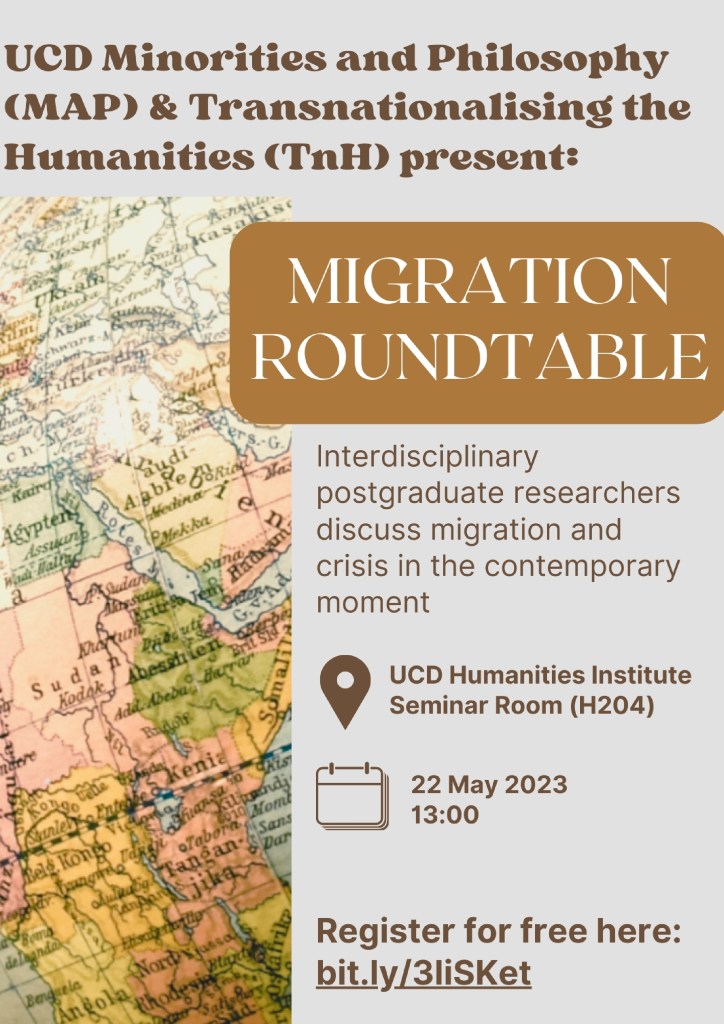
On 22 May 2023, I helped organise a collaborative event by the Transnationalising the Humanities (TnH)-PhD Network and Minorities and Philosophy (MAP) UCD Chapter. I was the chair of the TnH Network at the time, so my role at the event involved collaborating with both networks to agree on a format and guiding the discussion.
The format was an open conversation between members of the TnH-PhD network and members of MAP. At the start of the event, the participants will start from a previously agreed upon set of questions. The plan is then to open the floor to participants and attendees so that everyone can chime in as they please.
Some of the questions discussed at the round-table were:
Is there a lack of cross-cultural empathy when it comes to immigrant and refugee populations? Is this lack of empathy a result of the inherent need to reject competing notions of national and/or cultural identity?
How have the structural reasons for migration, both economic and political, shifted and changed as part of globalisation? How has our perception of migrants changed? How can this be reimagined?
What are the ways in which migration is linked with capitalism, racism, and/or neocolonialism? Are concerns about migration raised with the same level of urgency in the “Global South” context, or are these concerns predominantly “Global North” concerns? How are we to decolonise our understanding of “migration”?
Is migration a transnational phenomenon? How are we to think of migration justice not from the point of view of the state—which tends to misrecognise the politics of needs at the transnational level, but from the point of view of migrants—which demands a transnational understanding of needs.
The paradoxical state of being racist by degrees: What do we think racism is? Why is there such a disparity between the way coloured migrants are perceived in most European countries vis-à-vis European migrants? What makes this phenomenon peculiar is that this disproportion doesn’t depend on the narrative of a culturally united Europe, or on a stock of shared values and principles: not all European countries are tied by friendly relationships; many lament deep dissimilarities of customs, political views, ideologies and cultures hiding beneath the appearance of the union. Does this cleavage in the differential perception of different migrants rest on bleak racism? Is racism an absolute notion or does it make sense to say that there are grades of racism?
For more on the Trans-nationalising the Humanities (TnH) PhD Network, visit https://www.ucd.ie/humanities/research/transnationalisingthehumanities/phdnetwork/ and for more on UCD Minorities and Philosophy (MAP), visit https://www.ucd.ie/philosophy/edi/map/
 poojasastry.com