this series is part of my dissertation, funded by the ERC project ‘Expanding Agency: Women, Race and the Global Dissemination of Modern Architecture’ based in the UCD School of Art History and Cultural Policy
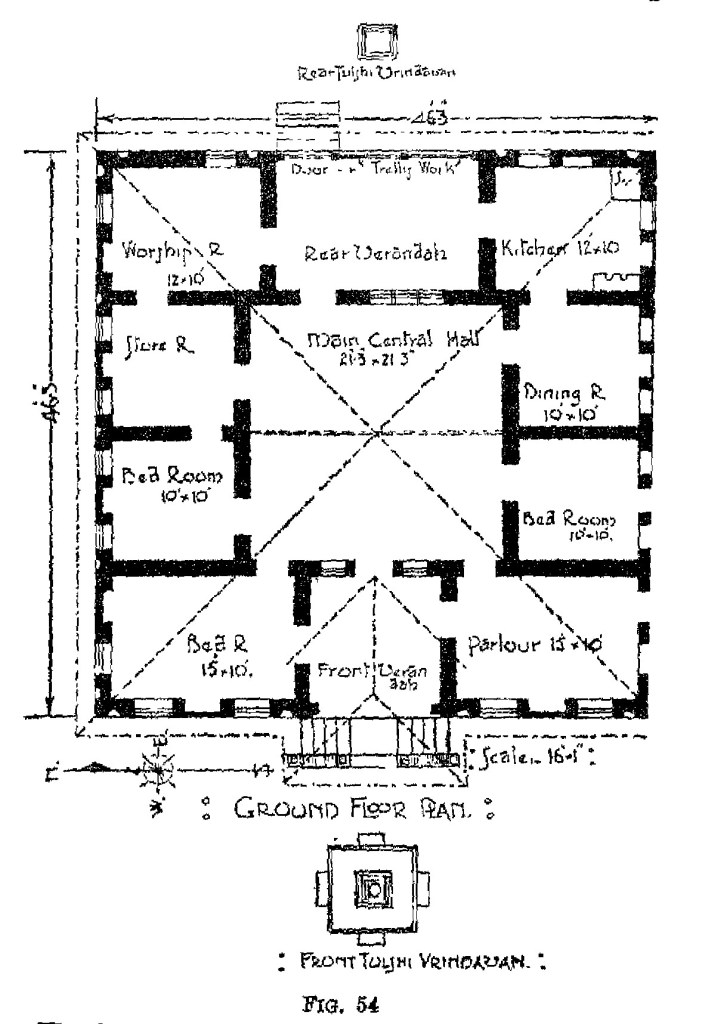
In Residential Buildings Suited to India (1931) and Cheap and Healthy Homes for the Middle Classes of India (1935), two construction manuals from Poona, British India, engineer Raghunath Shripad Deshpande instructed his upper caste middle-class readers on how to build their own single-family homes based on colonial public health policy, the then-emerging tenets of climatology, and nationalist reclaiming of ‘Hindu traditions’. Published in multiple languages and advertised in newspapers, Deshpande’s manuals were an authoritative voice in the larger Bombay Presidency. The manuals’ placement of rooms for ‘purification’ by the sun, tulsi plant shrines, long lists of cleaning tasks, and the removal of the latrine from the main house recreated caste-based exclusion by justifying them in the language of scientific rationality and hygiene. The manuals were so influential that later attempts at housing design in independent India bore traces of Deshpande’s vision of small-town Hindu upper-caste domestic modernity.

This project has received funding from the European Research Council (ERC) under the European Union’s Horizon 2020 research and innovation programme (Grant agreement No 101019419). Funded by the European Union. Views and opinions expressed are however those of the author(s) only and do not necessarily reflect those of the European Union or the European Research Council Executive Agency. Neither the European Union nor the granting authority can be held responsible for them.

