UNDERGRADUATE STUDENTS – YEAR 4 (FINAL YEAR PROJECT)
480 HOURS – 16 WEEKS HYBRID (ONLINE AND IN-PERSON)
This was a Bachelor of Design Final Project studio in the Srishti Manipal Institute of Art, Design, and Technology which I co-taught with my colleagues, artist Soumya Menon and illustrator Shubhshree Mathur. Unlike the shorter 5-week and 2-week studios taught to Year 1, 2, and 3 students, the final year project studios run for the full 16-week span of the semester.
At Srishti, the Semester 8 Final Project is run as an interdisciplinary studio, with students from multiple disciplines across the different programmes offered at Srishti. In our studio, we had students who had finished their first three years of education in Human Centered Design, Information Arts and Information Design Practices, Creative Education, Visual Communication & Strategic Branding, Industrial Arts and Design Practices, and Creative and Applied Computation, so the discussions were very lively.
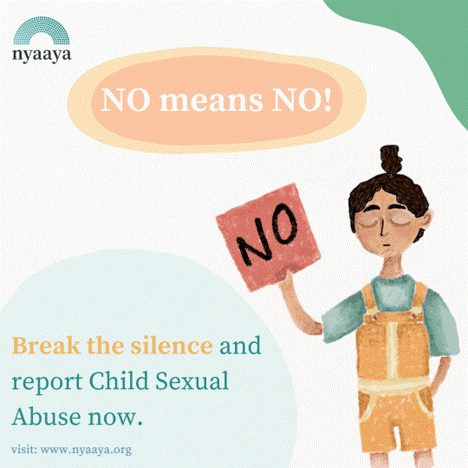
The project was in collaboration with Nyaaya, a digital resource run by a team of lawyers who condense legal information (policies, acts, rules, regulations, and court judgements) into “explainers” to make it immediately useful to those who may need it in an emergency. The task for students was to read and interpret those explainers (and often the source laws themselves) for dissemination to wide audiences, especially citizens who may not be able to read or speak English. The work was made for Nyaaya’s website, and thus had to be entirely digital.
Authoritative legal content which is engaging and actionable is a less-explored creative space in India. The intention was for the students to develop a live project while learning to work with a client. The hope was that it would build creative confidence – since it was close-ended, it would allow them to teach themselves a new skill if they so wished.
The main input from Nyaaya came after the students produced their first prototypes, and to their credit never gave any comments unless they had reviewed everything thoroughly as a team, so that the students would not be confused by conflicting advice from each individual Nyaaya team member.
The information had to be taken apart and augmented and recombined in new forms for each student’s medium and doing this was possibly the most painful part of the project for us all, because it involved pushing back at Nyaaya, who didn’t understand that this was required or indeed even counted as work. In their imagination, all the work had already been done by them and the students just had to make it “pretty”.
Another difficult aspect was narrative voice. From Nyaaya’s point of view, the information has to be legally authoritative, which means that it cannot be political or partisan. We had to tread the line between communicating the law and expressing a position on the law. This was not easy because the laws are both very heavy AND very close to everyday experiences: sexual crimes, arrest, maternity benefit, domestic violence, narcotics. The temptation to critique and be overtly political was irresistible.
The outcomes included websites, comics, scroll illustrations, motion graphics, animated and live-action films, and interactive illustrated guides.
To see student-designed explainers that are now available to the public, see https://nyaaya.org/guest-blog/6-things-you-didnt-know-about-the-right-to-education/, https://nyaaya.org/guest-blog/how-to-enroll-your-child-into-government-schools/, https://nyaaya.org/guest-blog/a-visual-guide-to-maternity-benefits-in-india/ and https://nyaaya.org/guest-blog/income-tax-simplified-for-salaried-individuals/
 poojasastry.com