UNDERGRADUATE STUDENTS – YEAR 1
60 HOURS – 2 WEEKS IN PERSON
‘Material; Form Making’ was a Bachelor of Design Year 1 module in Srishti Manipal Institute of Art, Design, and Technology which I taught in 2021. The module was run as an intensive 10-day workshop in which students were required to experiment with materials and ways of putting them together that would successfully resist compressive loads, tensile stress, bending, shear, and torsion that may be caused due to wind, rain, fire, or the structure’s own weight.
However, the workshop was not simply to teach students the mechanics of structures and ways of putting structures together, but also to help them place the above in context. The students were asked to reflect on the fact that skills are not “neutral”, especially structures and building: they often have a history of violence and oppression attached to them.
The following is a record of the activities that I and the students did each day:
Day 1: Make scale models (using only paper) of unusually shaped famous buildings, to understand how shape can create stability. Then break or dismantle their own scale models to see where the points of failure are, and how paper behaves with water and fire.
Day 2: Create a structure as tall as they can by stacking playing cards, plastic takeaway containers, and jenga blocks (first without sticking, then using tape/putty) to learn that symmetry and even spacing is conducive to stability.
Day 3: Build framed structures (post and lintel) and trusses from cocktail sticks, matchsticks, ice cream sticks and straws, to understand gravitational and compressive loads.
Day 4: Make a small structure using the same materials, but which is symmetrical about an axis, so that when they suspend it with a string, it gains its equilibrium from the axis of the string. A lamp, a pendulum.
Day 5: Modify the framed structures and trusses from Day 3 by replacing some of the sticks with string and pulling the strings to strengthen them.
Day 6: Practise different kind of structural knots, hitches, bends and types of lashings, to understand how they behave. Tie together furniture in the studio with strings to see if the knots support the weight of the furniture.
Day 7: Read about the challenges that migrants, refugees, and the homeless face in cities. They are often forced to live in makeshift (but weatherproof) shelters of tarpaulin, rope, and any vertical supports they can find, and these take skill to build. Make a small model of a weatherproof shelter, maybe 20cm by 20cm, using a MINIMUM of material. Make the roof for this weatherproof shelter twice: once with vertical supports and again using only string, to understand that roofs can be held up with cables alone.
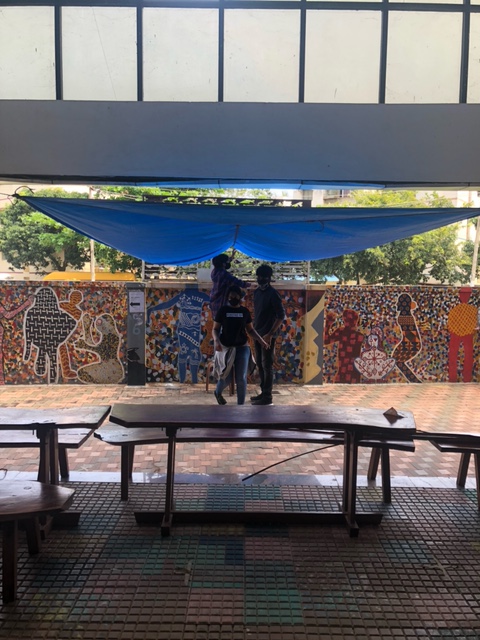
Day 8: Buy and bring material from the hardware shop. Construct the first trial of human-scale homeless shelters in the ground floor of N3 around the building, using tarpaulin, jute rope, and split bamboo/PVC pole scrap from N6 and N3 for vertical support.
Day 9: Continuation of trials of human-scale homeless shelters, practising secure knots, lashing together the vertical supports and using manhole covers, angle supports along the side of the building, and drain grills to anchor ropes.
Day 10: Construction of final shelters, which were left up for 24 hours (the above image is one of the final structures made by students).
 poojasastry.com