POSTGRADUATE STUDENTS – YEAR 1
30 HOURS – 10 WEEKS IN PERSON
‘Digital Cities’ was a Master of Design Year 1 module in the Srishti Manipal Institute of Art, Design, and Technology which I taught in 2019. The module is open to students of all postgraduate taught units in Srishti, and the studio had students majoring in Design-Led Innovation, Human Centered Design and Industrial Arts and Design Practices.
The unit was intended to explore urban systems and the possibilities of digital technology to bring positive change to them. The unit was also intended to equip students with research and writing skills. The submission at the end of the cycle was intended to be a written paper.
Students were asked in the first class to identify a topic of their personal interest, on which they were asked to write 100 words with references in the Chicago Style. They then developed this area of interest into an article by the middle of the semester, and eventually expanded it into a paper of 3000-4000 words by the end of the semester. The process was intended to accommodate inevitable changes in interests and topics.
Originally, the unit was meant to have only five classes, so I reserved the majority of the theory and discussion material for the first five classes. In the first five classes, the following five themes were explored:
- Digital Cities – Stakeholders: Exploring the various players and systems in a city, and identifying existing and potential digital possibilities
- Digital Cities – Ethics: The students worked in groups on real-life case-studies that explore the overlap of ethics, technology and justice.
- Digital Cities – Ecology: Humans are part of their natural environment, and digital cities must necessarily recognise this to be effective. The students were asked to situate ecological systems and sustainability at the centre of urban life, including their own, and examine their practice through this lens.
- Digital Cities – Governance: Well-designed systems are necessarily shaped and altered by governance and policy. How and why? The students worked in groups to understand the current relationships between technology and governance, and built scenarios to explore future possibilities.
- Digital Cities – Innovation and the New Economy: The students discussed emerging technological innovations for their potential to address emerging social and environmental issues. In a team exercise, students reviewed each other’s projects through the lens of emerging technologies and their capacity for disruption.
The nature of learning supported was learning to read, learning to synthesise their learnings from reading, forming a point of view and learning to articulate their point of view as it relates to the larger body of research work on their chosen subject. The unit was almost entirely structured around their individual papers and what they wanted to write it on.
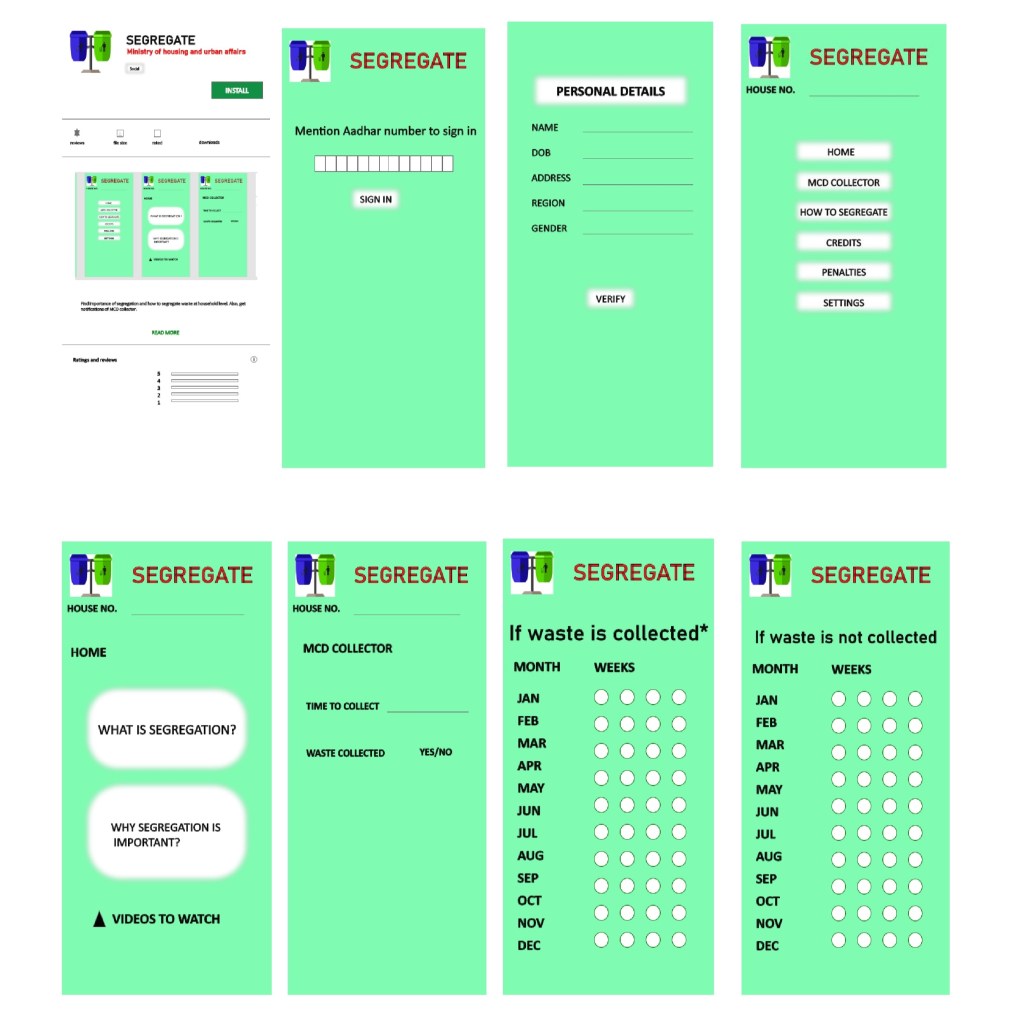
The students were exceptionally quick on the uptake and sharply intelligent. They chose challenging themes to tackle and each student overcame some obstacles in his or her own way. Some of them faced the obstacle of not having enough confidence to write, some requested support with research methodology, and some overcame their own discomfort with critique and suggestions. The above image is of wireframes for an application designed for householders to help them comply with waste segregation laws, which student Harshita Hassani developed as part of her final research paper.
 poojasastry.com