Client: Mahila Housing Sewa Trust
Done as part of a team when I was working with Integrated Design (a practice that works at the intersection of environmental management and regional planning), this project required us to evolve tangible recommendations for Natural-Resource based Amenities and Services Provisioning for the urban poor in the city of Ranchi, Jharkand, in eastern India.
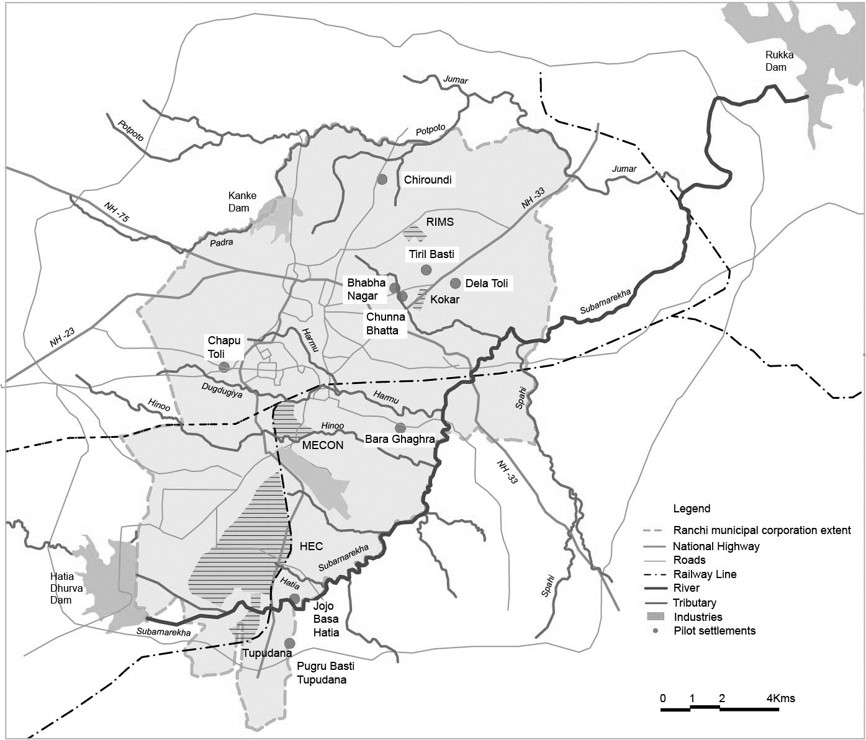
As part of the team, I helped identify and map the water resource-rich areas in Ranchi region and analyse the land use patterns (existing and proposed) to examine the spatial and functional linkages and relation to resource regions. The above map shows informal and urban poor settlements that are spatially linked to any water or landscape resource areas. The map was made to understand the dependencies between natural resources and communities.
Where possible, we also attempted to map land ownership – individual and community wells – in the informal settlements to gain a deeper understanding of community dependencies. The Integrated Design team also examined water quality issues by guiding the Mahila Housing Sewa Trust staff on how to obtain scientific water quality data.
The key outcomes were policy suggestions to evolve water resource management plans from the regional resource mapping exercise, recommendations for improving or carrying out land use planning exercises, and actionable recommendations and interventions for pilot cases to improve living and livelihood conditions of the urban poor by utilising the services provided by the natural water resources and resource regions.
For more about the project, visit https://www.mahilahousingtrust.org/knowledgehub/handbook-for-enhancing-water-security-in-communities-a-case-of-ranchi-city-2/

